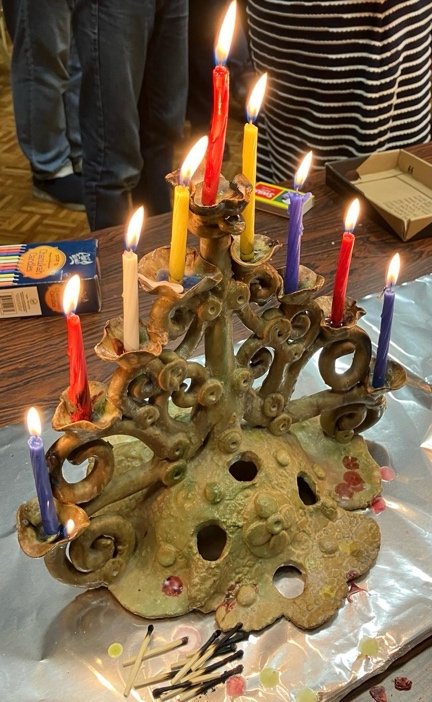
Chanukah (or Hanukkah) is an 8 day holiday also known as the Jewish Festival of Light. In 2025, Chanukah will be celebrated for the second time between sundown on Sunday the 14th December, and sundown on the 22nd of December. It ordinarily takes place once a year, but as the dates are dependent on the Hebrew calendar, it can sometimes cross over into the next secular year. 2025 is one of those years. It always starts on the 25th day of the Hebrew month of Kislev, which normally falls in November or December.
Fun fact, in 3031 there will be no Chanukah at all. But since none of us will be here to worry about that, we’re going to concentrate on the here and now. The reason that gave rise to the three year battle in which the Jews successfully defeated the much stronger Syrian-Greek army was actually deemed a culture clash…
Normally when we see Jewish celebrations or hear from members of the community in the UK, they are very…white. Some people don’t realise there are many Black Jews, as well of Jews of Colour. And no, they are not all mixed race either.
Zakaya Media spoke to three Jewish folk about Chanukah, what it means to them, and ask what bearing, if any, their culture has on the way they conduct their celebrations.
Rededication in Exile: A Maghrebi–Sahelian Hanukkah in the UK – Kenneth Okafor-Anene
Being a British Black Jew of Maghrebi-Sahelian descent, I observe Hanukkah as a memory, a source of strength, and a diasporic statement. Historically, Hanukkah commemorates the rededication of the Second Temple in Jerusalem by Jewish warriors known as the Maccabees. The name, Hanukkah, means dedication, in remembrance of a miracle, in which oil that was supposed to last a day lasted eight days.
But I disagree with nationalist and militaristic explanations of this festival. To me, rededication is not about land or independence but rather about regaining diasporic holiness: the body, the home, the language, the tale. The aspects I consider sacred are mobility, hospitality, intergenerational survival, and the memories I carry with me from Fez and Tunis, through Timbuktu and Dakar, to Lagos and London.
The menorah I light does not symbolise a win, it is a light in the dark. It is the continuation, dignity and cultural light in exile. Every flame is a reminder of the ancestors who survived colonialism, displacement, and erasure by Moroccan villages to Sahelian markets, Jewish families in Tunisia under French rule, and diasporic Jews in Nigeria and Senegal who had to navigate between overlapping faiths and identities.
The oil I commemorate does not belong to the lamp of the Temple because it is peanut oil, argan oil, shea butter, and the invisible fluid that sustained and nourished the African Jews on their centuries-old journey of migration and marginalisation. It represents the silent survival of secret female practices, border-cutting businesspersons, and communal meals in heterogeneous communities.
My Hanukkah dwells on hospitality because it is the open tent, the shared table, and eating and remembering together. I invite family, friends, and neighbours, Jew and non-Jew, to recommit ourselves not to nationalism, but to solidarity, justice, and cultural delight. Our temple is not a structure, but the meal we eat, the stories we preserve, the songs we remember.
On my table are the dishes that remind me of my diasporic background: fried chickpea cakes with cumin and peanut, candied yams with date syrup, and sfenj, the sweet North African doughnuts that were passed down through the generations; and, to eat, Egusi soup and pounded yams, which are common dishes in West African cuisine. These cuisines interrelate the land, ancestry and liberation. They are reminding us that we are African, mobile, and unashamedly diasporic as Jews.
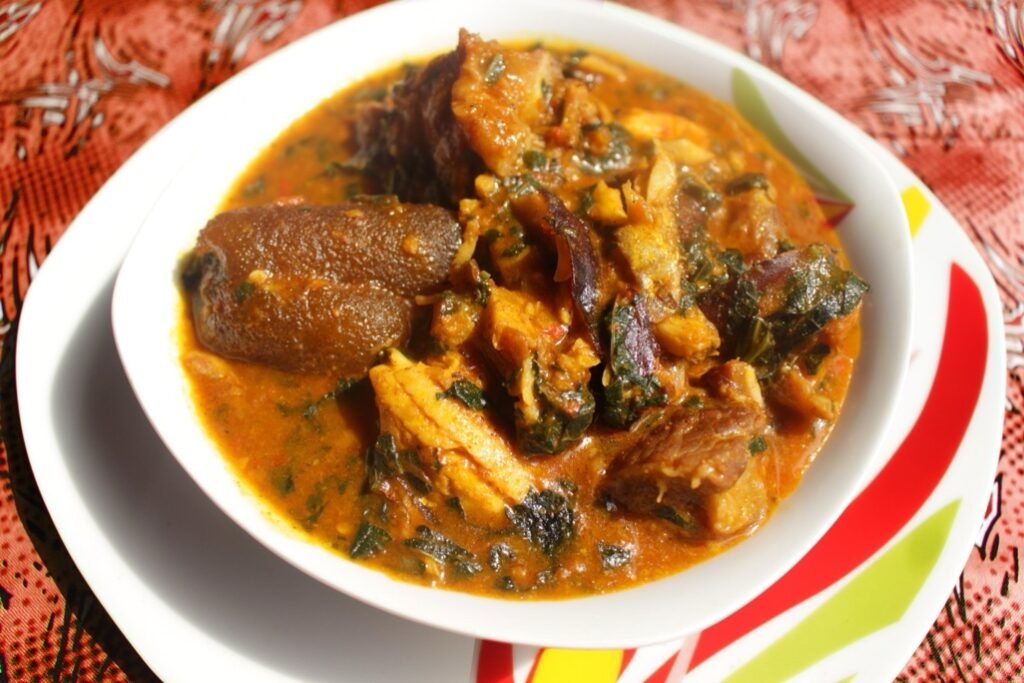
Ogbono Soup
Hanukkah is also a day of creating a future. I do not celebrate to relive an ancient war; I did it to show younger generations that being Jewish does not mean being white, nationalistic, or a state, it can be Black and African, multilingual and anti-colonial. That the light still shines, not due to authority, but due to defiance, hospitality, and memory.
We are the Jews of the dunes and the riverbanks.
We do not recall fortresses, but fires in courtyards, in caravans, in secret rooms of learning.
We disown the myth that statehood alone completes us.
The food we eat, the speech we speak, the right we do, is our temple.
Hanukkah is not theirs to make a weapon of because it is our living, and we shall live, time after time, in every exile that spared us intact.
Here in the UK, I take each candle as a re-dedication to diasporic truth, which places Fez, Tunis, Dakar, Anambra, and Sheffield in the same sacred fire.
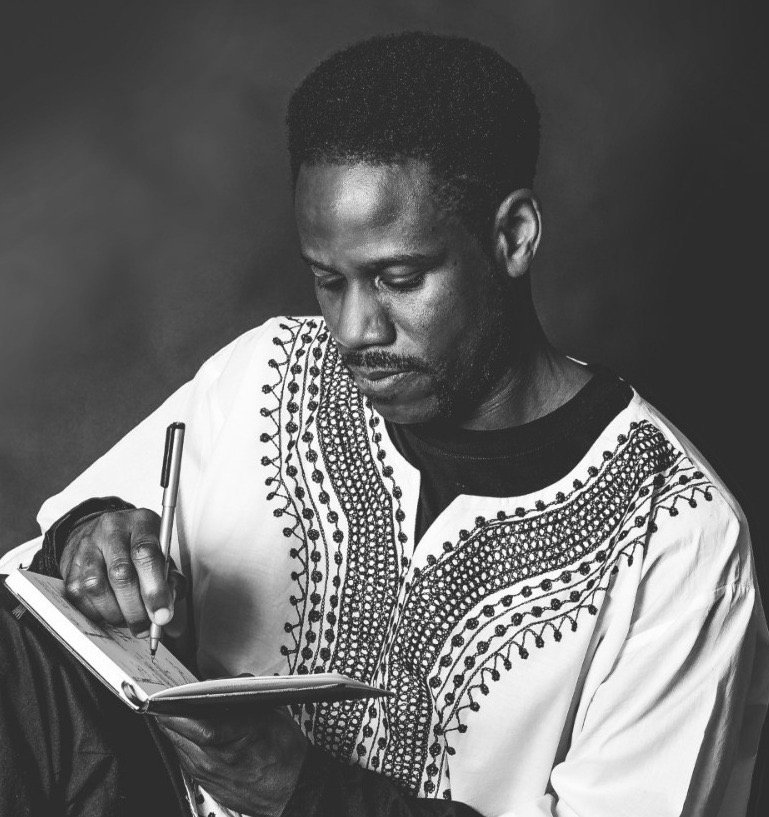
Photo courtesy of Kenneth Okafor-Annene
Chanukah in India – Shailee Talkar
Honestly, I haven’t seen Chanukah celebration anywhere else other than India hence I don’t know how it’s celebrated elsewhere. But it’s been a big part of our lives here in India.
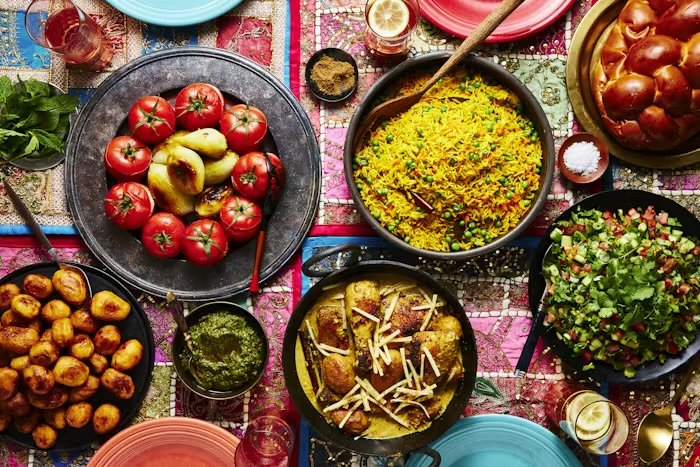
Photograph by Penny De Los Santos. Food Stylist: Judy Haubert
There are no public holidays or even much known about Chanukah to rest of the population as Jews here are now less than a minority. Jewish presence in India stretches back over 2000 years and we have always lived peacefully alongside the locals of other religious persuasions. Many left after the creation of Israel. In 2020 there were less than 5,000 Jews left living in India. So, we really are a tiny community. Jewish assimilation into Indian culture in respect of food has always taken place creating some amazing dishes such as Kubbeh, Arook and Hanse Mukhmura that follow kosher rules but typically have a Middle Eastern influence, as many Jews in India originally came from Baghdad. Challah Bread and Laktes are eaten but they are flavoured with Indian Spices. A popular Shabbat dish is slow cooked chicken stuffed with spicy rice and eggs called Hamim.
We were 3 siblings in our family, so singing songs while lighting Chanukiah was so much fun. At our place and in fact in most of Indian households, we had oil glasses and not candles.
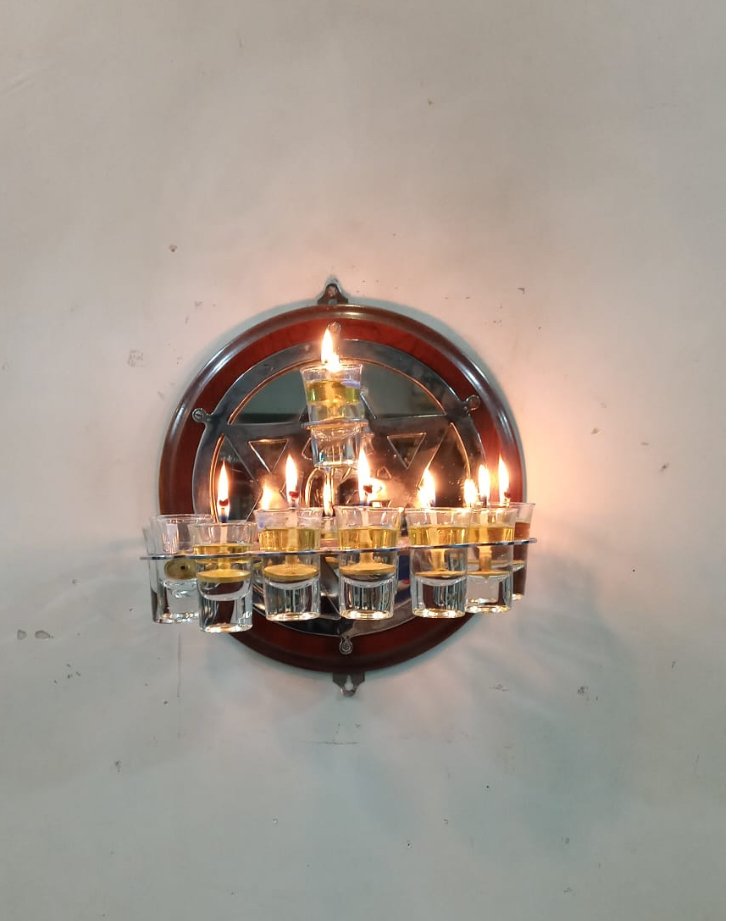
Attached is a picture from my father’s house during Chanukah
Everyday 3 of us took turns to light the glasses and sometimes even fight over who will light on the last day as that person had the most to light. That was the excitement level.
This is how we do it! African-American Chanuka Celebrations – Belle Tarsitani
I am really looking forward to Chanukah this year as it will be a little different. I am going to spend some of it in Morocco where they used to have the highest percentage of Jews in the Arab world. There used to be ¼ million Jews residing there. There are a lot of traditions and heritage to explore and as well as many museums to visit so I’m really excited about that. The rest of the time I’ll be here at home so I will carry out my own traditions too. Earlier this year I actually went to the Kotel (Western Wall) that dates to the time of the Second Temple when the Maccabean Revolt and the ‘miracle of the oil’ or ‘miracle of Chanukah’ occurred.
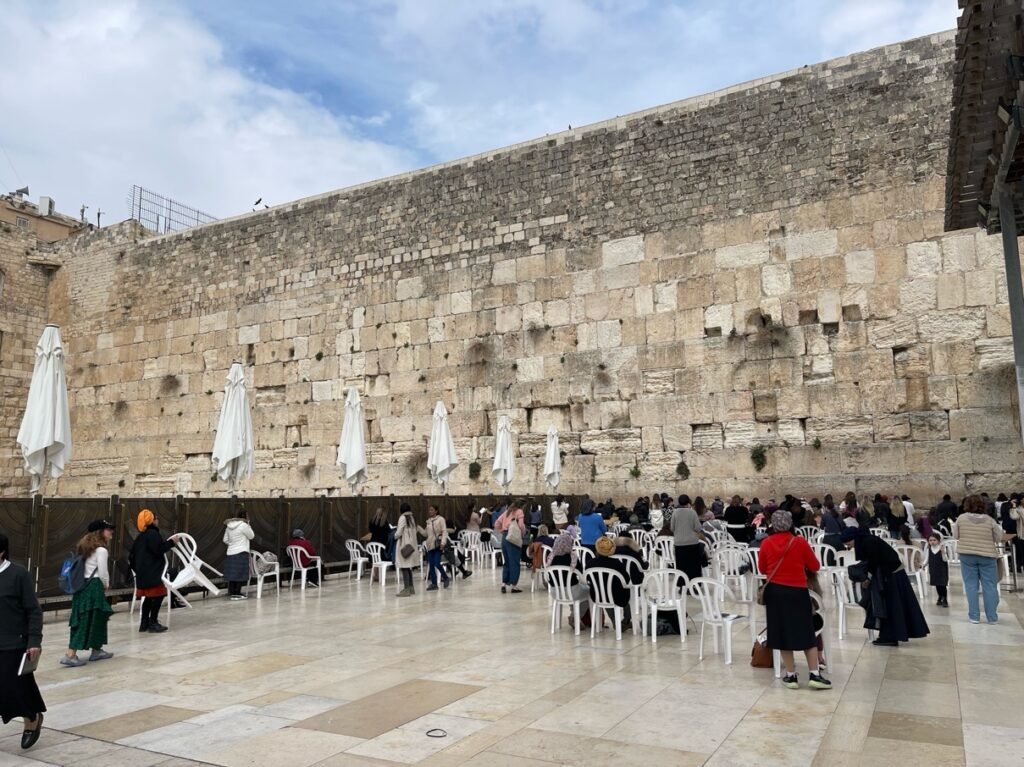
Western Wall – Women’s Section, Old City, Jerusalem
I’m the second generation of my (African American) family to convert to Judaism as an adult. As I’ve lived abroad most of my life, I don’t feel constrained to carry out the same practices as my Jewish family in America. I’m very free to choose my own way to celebrate things. There are certain things that all Jewish people will do, such as lighting the Chanukiah (menorah), reciting certain blessings from our sidor, having communal meals in the synagogue, that will be done. But when it comes to other things like the tradition of eating a lot of fried foods, my culinary tastes are a little different from my Ashkenazi fellow synagogue members. For example, when it comes to laktes which are fried potato cakes which are very popular, mine will be made with sweet potatoes. I’ll probably fry some okra too as one of my fried dishes. I don’t normally eat fried foods, so I am going to choose things that are more suited to my African American palate. I am also going to make some Sfenj which are Moroccan fried doughnuts. That’s a Moroccan Jewish tradition.
Also, the soundtrack to my Chanukkah is probably different from other people’s. When I’m in the kitchen making Challah which I do love to make, I’m often listening to Nissim Black, who is an Orthodox Jewish, African American Israeli rapper. He’s from Seattle but he lives in Israel now. He wears the traditional Hassidic hat and so forth. I also enjoy listening to music that is influenced by the Judeo-Arabic poetry and musical traditions like The Piyut Ensemble who are an Israeli group. I feel that music is more to my liking, so I enjoy that. I would say that food and music are the ways I express my ethnicity in my Chanukah practices.
My journey to Judaism has been a long one. My stepmother converted many years ago, and she and my mother raised their adopted daughters as Jewish, but I was an adult living abroad when that happened. But they are very used to celebrating all the Jewish traditions and I didn’t experience that with them. I decided to convert much later. In fact, I only converted last week! I went to my Beit Din ceremony last week and I had my confirmation in synagogue, but I’ve been attending synagogue for years. My family of course were elated. My mother is not Jewish and if you ever want to do another interview on the forced conversion into Christianity of our people and everything else, as well as the conversations I’ve had with my mother about why I made this choice, I’d love to! Of course, they’re all very supportive and know I always break the mould. I knew from around the age of 13 probably that I was going to convert to Judaism, I just kept putting it off, I mean who coverts to Judaism?! No one. And even after my family converted, I was so supportive but if you’re not doing it because of a child or because you’re getting married, it’s just so unusual. But when I went to Africa, I started to really think about it. I went to the University of Ghana in Accra, I started to think about my legacy, family, traditions and everything. I recently went to a University event in the UK, and there were six other African Americans in attendance, and we had all converted to another religion. Every one of us was very highly educated and had a master’s degree, if not a PHD, we had all visited Africa and when we came back, we started questioning everything, and then finally went on this path towards conversion. I keep wondering why someone doesn’t do research into that. My days of researching are over, but someone needs to do it. We have a unique voice. But that conversation will have to wait until after the holidays!
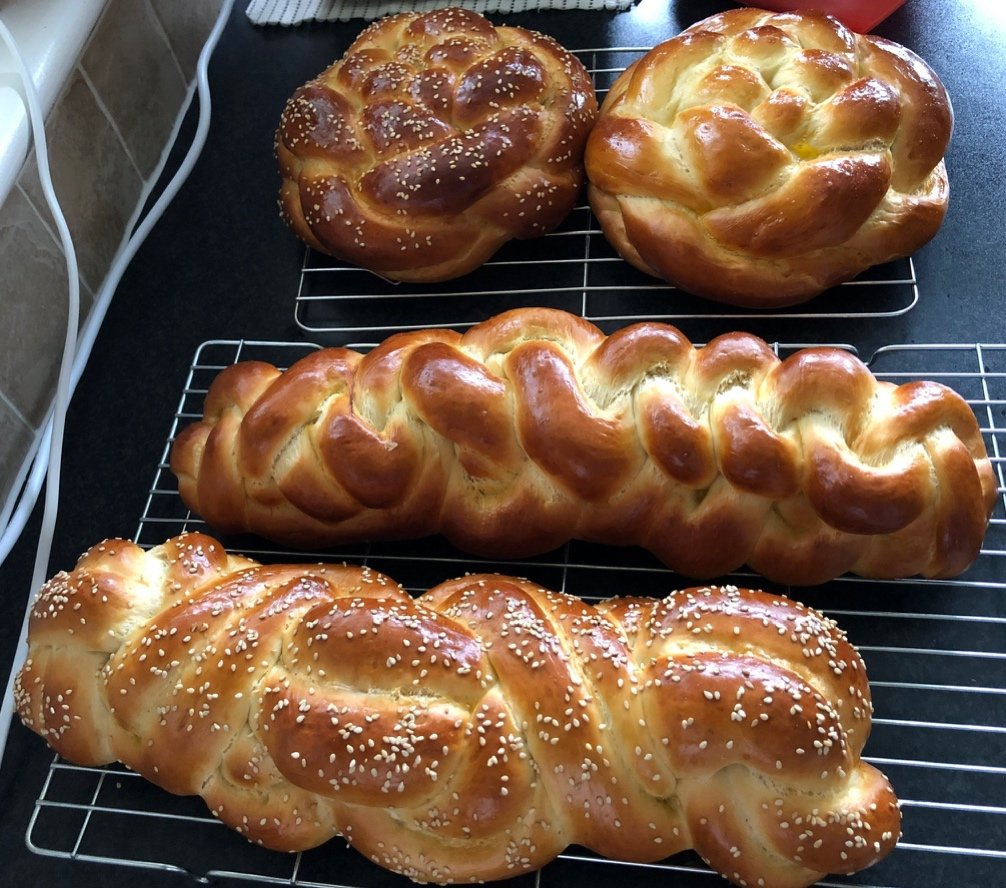
Belle’s delicious homemade Challah bread
Chag Sameach to one and all!